By continuing to read, you confirm you are of appropriate age.
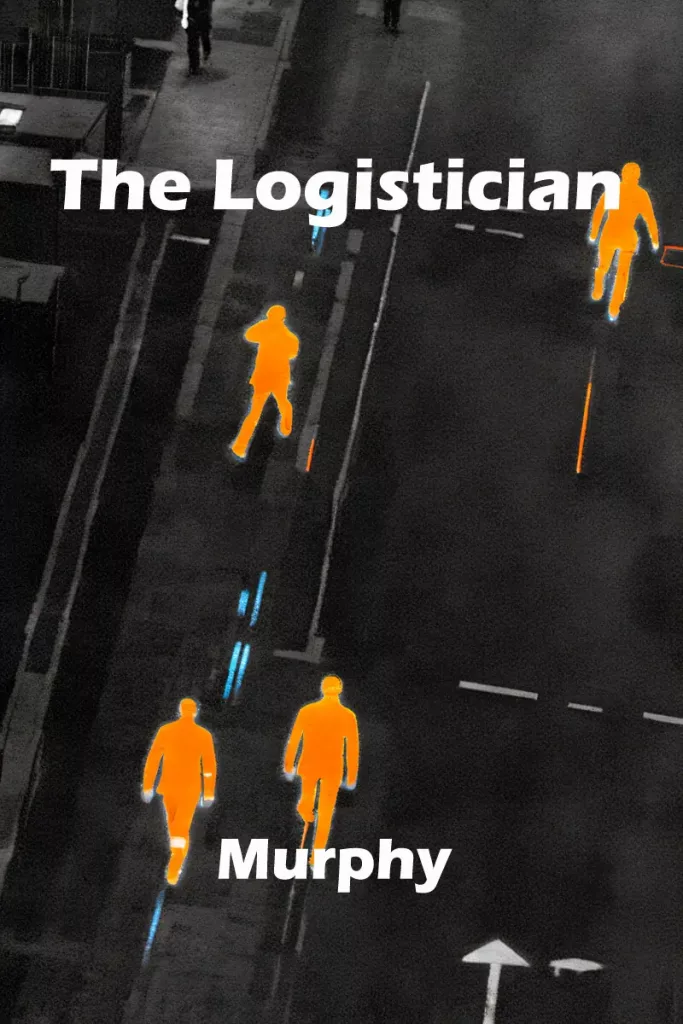
The Logistician
Murphy
Copyright Information
Frequent Traveler
First Edition. April 27, 2026.
Written by Murphy
Copyright © Murphy
All rights reserved. No part of this book may be reproduced, stored in a retrieval system, or transmitted in any form or by any means, electronic, mechanical, photocopying, recording, or otherwise, without the prior written permission of the publisher.
This is a work of fiction. Names, characters, places, and incidents are products of the author’s imagination or are used fictitiously. Any resemblance to actual events, locales, or persons, living or dead, is entirely coincidental.
www.murphyseyes.com
E-mail: [email protected]
Content
Chapter 1 The Hamburg Vector
Chapter 2 The Binary Response
Chapter 3 The Procedural Deviation
Chapter 4 The Telemetric Intersection
Chapter 5 The Residual Friction
Chapter 6 The Analog Anomaly
Chapter 7 The Latent Variable
Chapter 8 The Kinetic Discrepancy
Chapter 1 The Hamburg Vector
Listen to the Audio narration with authentic station ambience:
🎧 Recommended with headphones for best experience
The digital display above the platform flickered, the red LED numbers updating with a rhythmic, mechanical indifference. Five minutes. Twelve. Twenty-one. Thirty-two. The ICE train sat motionless at Düsseldorf Central Station, the hum of the idling engine the only constant in the stagnant air of the carriage.
Paul Anderwood had occupied compartment 21, seat 87, since the train departed Hamburg. The journey was supposed to be a straightforward transit through the Rhine-Ruhr region, but the schedule had eroded in increments. He watched the platform through the window. He didn’t lean against the glass; he kept a slight distance, aware of the thermal transfer. He knew the physics of the pane: if the light inside the carriage was dim enough, he was a shadow, a silhouette to those on the platform. He waited for the moment when a passerby might catch his eye, a brief moment of human recognition, but the crowd flowed past with a practiced, rhythmic apathy. He was aware of the potential for scrutiny, the way a passenger might glance at a man sitting too still, as if observing a specimen in a glass enclosure. But no one looked. No one cared. To the commuters on the platform, there was no spectacle in a man in a cage when everyone else was trapped in their own.
He turned his gaze to the platform, a habit born of long, unnecessary periods of stasis. He watched the people, cataloging them with the detached interest of a man reading a ledger.
He noted an elderly woman near a trash receptacle, her face a map of fine lines, waiting with a stoic, weary patience. He saw a group of university students, huddled together in a tight circle, their attention anchored to a shared smartphone screen, oblivious to the station’s automated announcements. He watched the commuters in their repetitive loops—the checking of watches, the readjusting of bags, the rhythmic pacing of those running late. It was a sea of predictable, individual trajectories.
Then, his gaze drifted toward a pillar near the edge of the platform. A man in a heavy, charcoal-colored business suit stood there, his face illuminated by the blue light of a smartphone. He was mid-sentence, gesturing vaguely at the air as he spoke into a wireless earpiece. At his feet, a leather briefcase sat unanchored.
Moving toward him was a girl, perhaps ten or twelve, wearing a dark, oversized sweater that seemed too heavy for the late summer humidity. She carried a long, beige trench coat draped over her right arm, the fabric bunched in a way that suggested it was being used as a shield. Her movement was precise, navigating the gaps between commuters with a practiced lack of friction. As she passed the man, the coat swung outward, a momentary obstruction in his line of sight.
Paul watched the trajectory. It was a clean line. He didn’t move. He didn’t feel the urge to intervene. He simply noted the efficiency of the maneuver. The man would finish his call, pick up his bag, and walk toward his connection, unaware that the weight of his belongings had shifted. Everyone had their own trajectory, their own inevitable frictions.
The train jolted. The brakes released with a pressurized hiss, and the heavy mass of the ICE began to creep forward.
Paul didn’t check his watch. In Germany, a thirty-minute delay was less a failure of the system and more a standard feature of it. The reputation for punctuality remained, even if the reality was increasingly a matter of statistical probability.
The journey from Düsseldorf to Cologne was a short, predictable stretch of track. When the train finally eased into Cologne Hauptbahnhof, the familiar architecture of the station rose to meet him. He stepped out into the terminal, merging with the surge of commuters, the smell of damp concrete and ozone following him.
He moved through the station, following the automated flow of the crowd toward the exits. He found himself slowing near the edge of the station square. The sprawl of the station, the movement of the trams, and the looming, dark silhouette of the Cathedral were part of a landscape he had mapped out over three years of quiet residency. He stopped for a moment, looking toward Café Brandt across from the Cathedral, a place where the shadows were deep enough to disappear.
The route from Cologne Hauptbahnhof to Rodenkirchen was a series of deliberate, non-linear turns. He didn’t look back; he watched the reflections in the taxi’s side window, looking for the tell-tale, rhythmic persistence of a vehicle that refused to break the pattern. The city passed by in a blur of heat-soaked pavement and the rhythmic flicker of sodium streetlights. The late summer air, trapped between the buildings, still held the day’s warmth, smelling faintly of dry dust and diesel. He chose the taxi not for comfort, but to break the digital trail; the heavy density of CCTV at the tram interchanges and the predictable path of the U-Bahn made for a much cleaner data set for anyone monitoring transit patterns.
His apartment in Rodenkirchen sat overlooking the Rhine. The river was a dark, moving void beneath the bridge lights, reflecting nothing but the occasional shimmer of a passing barge. Inside, the air was still and temperature-controlled.
He stripped off his traveling clothes and stood under the spray of the shower, letting the hot water scrub away the grit of the train’s ventilation system and the stale atmosphere of the station. It was a functional reset, a way to wash off the day’s transit.
Dinner was a matter of utility. He moved through the kitchen with a practiced, solitary efficiency. He prepared a simple spread: a salad of bitter greens, a sandwich of dense rye, ham, and sharp cheese, and a second Kölsch. The beer was cold, the carbonation sharp and efficient—a necessary, bitter edge to cut through the heaviness of the meal.
As he sat at the small dining table, he opened his laptop. The screen’s glow felt intrusive in the dim room. He didn’t prepare a formal report; instead, he opened a secure video link. It was close to lunch time in Washington, D.C. He waited, the sound of his fork against the plate the only noise in the apartment, until the connection established.
The image of Stephen Wyen flickered into view. He was in an office, the light harsh and sterile, a stark contrast to Paul’s shadows. Stephen was mid-sip of coffee, looking slightly disheveled, the universal look of a handler in the middle of a long day.
“You’re late,” Stephen said, his voice crackling slightly through the speakers. There was no reprimand in it, just a casual observation, the kind shared between people who had navigated enough delays together to find the humor in them.
“Düsseldorf happened,” Paul replied, taking a bite of the sandwich. He didn’t bother with a formal greeting. “The ICE is losing its reputation. I think they’ve decided punctuality is optional this month.”
Stephen leaned back, a small, tired smile tugging at the corner of his mouth. “The German efficiency is a myth, then. Just like the myth that I get to sleep past six.” He paused, his eyes scanning Paul’s face through the low-resolution feed. “You look like you’ve been sitting in a metal box for six hours. Everything okay in Hamburg?”
“Hamburg was fine,” Paul said, leaning back, his gaze drifting briefly to the dark window overlooking the Rhine. “Routine. Just a lot of sitting.”
“Fruitful?” Stephen asked, sipping his coffee.
“The contact has moved into the second phase,” Paul said. He reached for his laptop, his fingers moving over the keys with a practiced, mechanical rhythm. “He’s successfully embedded himself into the primary logistics management system. The integration is deeper than we anticipated. He’s already begun routing the preliminary datasets through the secondary channel.”
Stephen leaned forward, the light from his office catching the fatigue in his eyes. “And the handover? Did he provide the actual manifests?”
“He did. I’ve just pushed the encrypted files to the secure drop. It’s the raw telemetry from the Hamburg terminal—shipment logs, customs clearances, and the digital signatures from the terminal’s automated gates. It’s a heavy load, though. I need you to run the verification against the Hamburg port’s baseline records. I want to be sure the metadata hasn’t been scrubbed or spoofed before we move to the next stage.”
On Stephen’s end, there was a brief, rhythmic tapping of keys. “I see the notification. The transfer is starting now. I’ll have the analysts run the checksums and verify the source authenticity. If the signatures match the manifest, we can start the deep-dive into the discrepancies.”
“It’s a start,” Paul said, reaching for his beer. The cold glass felt grounding in his hand.
“It’s a massive amount of data, Paul. If the integrity holds, we’re going to have a lot of cleaning to do before this is even worth a briefing in D.C.”
“The cleaning is always the hardest part,” Paul replied. He took a long pull of the Kölsch, the bitterness lingering on his tongue. “I’ll be offline for the next few hours. I need to catch up on some sleep.”
“Understood. Get some rest. I’ll ping you if the verification hits a wall.”
The connection severed with a soft, digital click. Paul closed the laptop, the sudden silence of the apartment pressing in on him. The screen’s glow faded, leaving him alone with the dark river and the rhythmic, distant sound of a barge moving through the water. The mission was a success, the data was moving, and for now, the system was still working exactly as it was intended.
The Wednesday morning market was a four-block trek from Paul’s apartment, a routine he maintained with a certain stubbornness. It was more expensive than the local discounters, and the scale of the produce was often inconsistent, but the air there—thick with the scent of damp earth, crushed herbs, and aged rind—provided something the supermarkets couldn’t: a sense of presence. It was a way to anchor himself to the city, to ensure he was actually living in Cologne rather than merely inhabiting it like a ghost.
He was standing before a stall specializing in Westphalian cheeses, weighing a wedge of Bergkäse in his hand, when the encrypted phone against his thigh gave a sharp, rhythmic vibration. The intrusion felt violent against the morning’s quietude.
Paul didn’t linger. He moved through the thinning crowds, navigating the narrow aisles of fruit and vegetables until he reached a quiet corner of the street. He stepped into the shadow of a closed kitchen supply shop, the metal shutters still pulled down, a cold barrier between him and the market.
He answered. “Paul Anderwood.”
“Paris,” Stephen said. The voice was stripped of its earlier fatigue, replaced by a clinical, professional urgency.
“Paris?” The question was instinctive. In his line of an agent, curiosity was a liability, but it was also the only tool he had left.
“La Défense,” Stephen clarified.
“That’s not Paris. That’s a business district with a skyscraper problem.”
“It’s the objective. I’ve just pushed the dossier to your secure drive. Read it. The parameters have changed.”
Paul leaned against the cold metal of the shutter, his eyes scanning the empty street. He didn’t need to open the file to understand the gravity. A mission to La Défense, involving the French DRM, meant the situation had moved past simple surveillance.
The dossier was brief, dense with technicalities. The mission was a retrieval. The target was Émeric Vauquelin, a high-level supervisor within the Direction du Renseignement Militaire. The context was a breach: a mole within the DoD Paris Station had leaked high-resolution satellite intelligence to the DRM. The integrity of the entire Paris station was compromised; no one could be trusted. Paul’s task was to act as the bridge—to meet Vauquelin, secure the identity of the mole, and facilitate the handover of a high-quality, forged passport that would allow Vauquelin to disappear.
Paul closed the phone. He looked back at the market, where the morning trade was progressing in its usual, understated rhythm—the quiet, professional exchanges of vendors and the muted rustle of paper bags. But the domesticity of the morning had evaporated.
Cologne Central Station was caught in the heavy, kinetic energy of midday. On platform 4, a cluster of grey, bloated pigeons scavenged through the debris of a discarded sandwich, indifferent to the rush of commuters. Paul moved through the crowd, a single, unremarkable thread in a thick weave of passengers. He was waiting for ICE train 8012, the 12:41 departure. The logistics were already handled; the e-ticket was active on his phone, first class, seat 63. The system was functioning with its usual, automated efficiency.
He found his seat and settled in, placing his messenger bag at his feet. He then took a moment to lift the bag, stowing it in the overhead rack, using the motion to cast a brief, disciplined scan of the compartment. There were fewer than five other passengers in the car. No one was watching him; no one was looking at him. The passengers were absorbed in the private, digital worlds of their own devices. He sat back down, returning to the stillness of the carriage.
The train pulled away from the station with a smooth, heavy inertia. The platform architecture slid past—a blur of concrete pillars and glass—before the urban sprawl gave way to the rhythmic, industrial landscape of the Rhineland. Factories and warehouses flickered past, followed by the dark, steady movement of the river.
Soon, the conductor appeared. It was the standard, choreographed hospitality of the first-class service: a perfunctory offer of newspapers, magazines, and small, sealed bottles of water. The service was a necessary ritual, a layer of professional politeness that preceded the more intrusive aspects of the journey.
Twenty minutes later, the rhythm changed. The conductor returned, the rhythmic tap of the handheld scanner signaling the arrival of the inspection phase.
Paul presented his e-ticket. The conductor scanned the barcode, the device emitting a sharp, electronic chirp. Then, without ceremony, the man held out a hand. “Your ID, please.”
The request was routine. Paul reached into his pocket and produced his passport. He watched the conductor’s eyes move across the bio-data page, verifying the name and the photograph. When the document was returned, Paul felt a minute, almost imperceptible change. The passport felt thicker, the edges slightly more rigid. He had received two documents, now pressed together in a single, seamless stack. He tucked them both back into his pocket, his expression remaining entirely neutral.
He stood and moved toward the lavatory at the end of the carriage. Once inside, he engaged the lock with a metallic click. He performed a quick, habitual check of the small, cramped space, ensuring no one was lingering near the door. Under the harsh, clinical light of the lavatory, he separated the documents. The first was his: Paul Anderwood. The second was the payload: Grant Rhodes. He studied the photograph embedded in the Rhodes passport, cross-referencing it with the encrypted image in the mission dossier. The facial structure, the gaze, the specific, heavy set of the jaw—it was an exact, seamless match for Émeric Vauquelin. Even the document itself had been prepared with a necessary, deceptive history; it wasn’t a fresh print, but a weathered booklet, its pages bearing four irregular, faded customs stamps from various international hubs. The forgery was perfect. The man Paul was going to meet was already, on paper, someone else. The transition had begun.
Read → Read: The Alphabet Series → The Logistician