By continuing to read, you confirm you are of appropriate age.
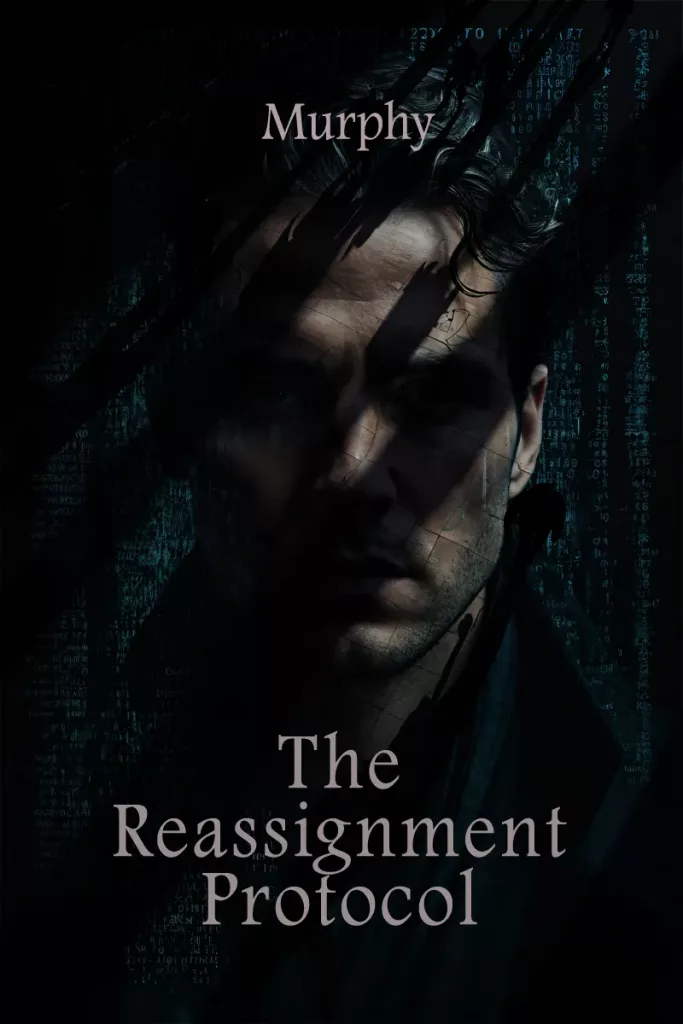
The Reassignment Protocol
Murphy
Copyright Information
The Reassignment Protocol
First Edition. May 15, 2026
Written by Murphy Copyright © Murphy
All rights reserved. No part of this book may be reproduced, stored in a retrieval system, or transmitted in any form or by any means, electronic, mechanical, photocopying, recording, or otherwise, without the prior written permission of the publisher.
This is a work of fiction. Names, characters, places, and incidents are products of the author’s imagination or are used fictitiously. Any resemblance to actual events, locales, or persons, living or dead, is entirely coincidental.
www.murphyseyes.com
E-mail: [email protected]
Content
Chapter 1 A Trial Order
Chapter 2 The Friction of Commerce
Chapter 3 The Flight Attendant
Chapter 4 Level Two
Chapter 5 Invalid Credentials
Chapter 6 CT Protocol
Chapter 7 The Leverage
Chapter 8 The Reassignment Protocol
Chapter 9 Borrowed Skin
Chapter 10 A Message
Chapter 11 Gate G37
Chapter 12 The Bill
Chapter 13 Null
Chapter 3: The Flight Attendant
The file appeared in the secure partition of his laptop during the quiet hours of the morning, a notification from the DoD’s internal encrypted channel that bypassed his standard mail servers. There was no physical courier, no paper trail—just a series of cascading decryption protocols that left Harrison staring at the blue light of the screen long after the sun had begun to grey the Berlin sky.
Asset: Andreea Stoica.
Harrison leaned back, the springs of his chair protesting in the silence of the office. His standard operating procedure was movement—pushing assets out of the European theater, toward the periphery where the digital dragnet was thinner. Keeping someone in the old heart of Europe, especially with a forged identity that had to withstand the scrutiny of German bureaucracy, was a liability. It was expensive, it was loud, and it was risky.
But the DoD instructions were explicit. Stoica was to remain in Germany. Harrison was to provide a temporary sanctuary, a low-profile existence, until the extraction window opened. He would manage her logistics, her movements, and her silence. He would be the ghost in her machine until the order came to move her for good.
The Berlin Brandenburg Airport was a cathedral of glass, steel, and bureaucratic inefficiency. It was a place of transit, where people were stripped of their privacy by scanners and redirected by automated voices. Harrison sat in a café near Terminal 1, a lukewarm espresso in front of him, watching the arrivals gate.
He had studied the digital dossier for three hours the night before. He had memorized the geometry of her face, the specific shade of her eyes, the way her hair fell. He didn’t look for her with the intensity of a man searching for a lost object; he looked for her with the casual, practiced indifference of a man waiting for a delayed flight.
Then, she emerged.
She wore the navy blue uniform of Polair, a mid-tier airline that operated enough regional routes to be unremarkable. The fabric was crisp, the silver pins on her lapel catching the sterile overhead light. She moved with the practiced, weary grace of a flight attendant—a controlled walk, a polite, distant expression that signaled she was part of the scenery. She was exactly what the dossier promised: a woman hiding in plain sight.
Harrison stood, leaving a few Euro coins on the table, and intercepted her near the transition to the taxi station. He didn’t approach from the front. He came from the side, a slight angle that wouldn’t trigger a defensive reflex.
“Where is Captain Copper?” Harrison asked. His voice was low, steady, stripped of any inflection that suggested importance.
Andreea stopped. She didn’t flinch, but her eyes sharpened for a microsecond before the mask of the flight attendant settled back into place.
“Captain Bopper,” she corrected.
The exchange was seamless. The error was the signal. By providing the correction, she had confirmed her identity without the need for a clumsy, overt passphrase.
“Yes, sorry.” Harrison allowed a brief, awkward smile to touch his face—the look of a man who had simply misremembered a name. “Captain Bopper.”
“Captain is on sick leave. Just me.” She offered a friendly, professional smile. It was a good smile. It was entirely too bright for the hour.
“Would you please follow me?” Harrison gestured toward the exit.
He didn’t wait for an answer. He turned and walked toward the parking garage, keeping a distance of three paces. He listened to the rhythmic click of her heels on the linoleum. It was a steady sound. Not the frantic gait of someone being hunted, but the measured stride of someone who knew exactly where she was.
The transition from the terminal to the garage was a descent into grey. The bright, airy optimism of the airport gave way to the heavy, concrete reality of the underground levels. The air here was different—cooler, smelling of damp cement and exhaust. The lighting was a series of flickering fluorescent tubes that cast long, sickly shadows across the parked cars.
They passed a security checkpoint, the guard barely looking up from his monitor. In this part of the airport, the machinery of surveillance felt sluggish, weighted down by the sheer volume of mundane commerce.
“The car is in Level 3,” Harrison said, his voice echoing slightly against the low ceiling.
“Is it far?” she asked.
“Not long.”
They walked past a row of silver Volkswagens and black Audis, all of them identical, all of them part of the European urban landscape. Harrison kept his eyes moving, not looking at her, but scanning the periphery—the blind spots of the CCTV cameras, the shadowed corners between the concrete pillars.
He felt the familiar, low-level tension in his shoulders. It wasn’t fear; it was the awareness of the friction. Every move they made, every step they took in this highly regulated space, was a calculated risk. They were two strangers walking through a basement, but in the eyes of the systems they were circumventing, they were a variable that didn’t belong.
They reached a nondescript, dark grey Skoda parked in the corner of a bay. Harrison pulled the keys from his pocket.
“This is it,” he said.
Andreea looked at the car, then back at him. The friendly flight attendant was gone. Her expression was neutral, her eyes assessing the vehicle, the surroundings, and finally, him.
“Does it have enough room for my luggage?” she asked.
“It has enough room for whatever you brought with you,” Harrison replied. He opened the passenger door. “And nothing else.”
Andreea sat in the rear, her silhouette framed by the passing grey smear of the Berlin outskirts. She watched the world through the glass with a stillness that wasn’t quite relaxation; it was the quietude of someone waiting for a collision. Harrison kept his eyes on the road, his gaze flicking to the rearview mirror every few minutes to check her posture, her breathing, the way she held herself against the vibrations of the Skoda.
The hum of the tires on the wet asphalt was the only sound for several kilometers.
“First time in Berlin?” Harrison asked.
“Germany,” she said. Her voice was low, a soft correction that carried no warmth.
“Sorry?”
“First time in Germany.”
“Ah.” Harrison adjusted his grip on the steering wheel. The streetlights of the B9 passed overhead in rhythmic intervals, casting strobing shadows across the cabin. “Not much to see. You haven’t missed anything.”
The silence returned, heavier this time. It was the kind of silence that exists between people who are acutely aware of the stakes. Andreea didn’t look away from the window, but her reflection in the glass caught his eye in the mirror. She was studying him as much as he was monitoring her.
“Why do they call you ‘Mr. N’?” she asked.
The question was sudden, breaking the professional distance they had maintained since the airport. It was a probe, a search for a crack in the composure he had spent years perfecting.
“‘N’ is Null,” Harrison said. He kept his tone flat, clinical.
“Null?”
“Zero.”
“I know what it means,” she said. She shifted slightly, her movement audible in the cramped space. She met his eyes in the rearview mirror, her gaze steady. “But why that name?”
Harrison felt the weight of the question. It wasn’t about the definition; it was about the philosophy.
“Just a designation,” he said, his shrug slight and economical. “Whatever they name me, I accept. It’s part of the contract.”
“It’s a lonely way to exist,” she murmured.
Harrison didn’t respond. He didn’t offer a rebuttal or a defense. He simply watched the road, navigating the transition from the industrial sprawl to the more residential, tree-lined streets of the district where the safehouse was located.
The silence that followed wasn’t empty. It was thick, filled with the unsaid things—the lives they had left behind, the identities they were currently wearing, and the uncertain, shadowed reality of what came next. They were both suspended in the present, moving through a city that didn’t know they existed, toward a destination that offered no guarantees.
Harrison steered the Skoda through the dense, grey arteries of the Berlin city center. He didn’t take the direct route to Wedding. Instead, he turned into a supermarket parking lot on August Straße. He didn’t park. He drifted through the rows of parked vehicles, circling the perimeter, watching the mirrors for any car that mirrored his cadence. He waited for the loop to feel clean, for the rhythm of the traffic to settle back into its natural, chaotic ebb. Finding no tail, he pulled back onto the main road.
He drove toward Wedding, the landscape shifting from the polished commercialism of the center to the more weathered, utilitarian blocks of the north. He finally turned onto Cornelius-Fredericks-Straße, killed the engine, and let the silence of the car settle for a moment.
They walked a block away, keeping their pace unhurried—just two people walking home from a shift.
The safehouse was a top-floor apartment situated at the junction of See Straße and Müller Straße. It was a loud corner of the city. Below them, the intersection was a constant churn of activity: commuters crowding the tram stops, the heavy rumble of buses, the erratic movement of people drifting in and out of the supermarket and the nearby cinema. The city’s noise was a constant, low-frequency vibration that would be manageable only if the heavy windows remained tightly shut.
The apartment was small, a one-bedroom unit that felt more like a holding cell than a home. It was functional, stripped of any personal touch. There was nothing for Harrison to show her, no art on the walls, no books on the shelves. It was a space designed for disappearance.
Harrison reached into his jacket and produced a small, laminated document. He handed it to her.
Andreea took the passport, flipping it open to the biometric page. “Raluca Popescu,” she read. She looked up at him, her eyes searching his. “Still Romanian?”
“Yes. Keep it real,” Harrison said. “Only temporarily. Truth is a better camouflage than a lie.”
“How long will I be staying here?”
“I don’t have a timeline,” Harrison said. He shrugged, a movement that was more a dismissal of the question than an answer. “I’m a passive actor. I follow the DoD’s lead.”
Andreea set the passport on the small wooden table in the center of the room. She looked around the sparse space, her expression tightening. “I need a laptop and an internet connection.”
“You know the protocol,” Harrison said. His voice remained neutral, devoid of sympathy. “Not possible. No signals, no footprints.”
“I need to know what’s happening.”
“You’ll know when I tell you.” He leaned slightly against the doorframe, his presence taking up just enough space to signal the end of the discussion. “Don’t go out. I’ll check in periodically. I’ll bring you what you need—food, essentials. Nothing else.”
He reached into his pocket again and placed a cheap, plastic burner phone on the table next to her new identity.
“Use this only when absolutely necessary,” he said. “If it rings, answer it. If you have an emergency, call. Otherwise, let it stay dark.”
He watched her for a moment, looking for a reaction—anger, fear, or perhaps just the exhaustion of someone who had realized the walls were closing in. She didn’t give him anything. She simply stared at the phone, a small, black object that was now her only link to a world that no longer recognized her.
The silence from the DoD lasted forty-eight hours. In Harrison’s experience, silence was rarely peaceful; it was usually the sound of a machine grinding to a halt or a signal being intercepted. An extraction was supposed to be a synchronized movement, a series of rapid, decisive steps. This long pause felt less like a tactical delay and more like a bureaucratic vacuum.
He wasn’t a babysitter, and he was running out of patience. A passport was a start, but a passport alone was a death sentence if the scrutiny became deep. He needed to build a legend—the digital shadow, the paper trail, the manufactured history that would allow Andreea to exist in the periphery of Europe without triggering alarms. He needed bank records, a rental history, perhaps a digital footprint of mundane social media activity. He needed an architecture of lies, and he couldn’t build it without the parameters of her new life.
He called Fred Ortiz. Ortiz was his supervisor, a man who existed in the friction between the field operatives and the political architects.
“No updates?” Harrison asked, skipping the pleasantries.
“The channel is quiet, Harrison,” Ortiz replied. His voice sounded tired, filtered through the low-quality encryption of a secure line. “They’re processing the next phase. I’ll coordinate with the liaison and see if I can get a window on the timing. Hang tight.”
“Hanging tight doesn’t build a legend, Fred. She’s sitting in a box in Wedding. That’s not a sustainable operation.”
“Just hold the line,” Ortiz said, and the line went dead.
Harrison spent the next few hours performing the mundane tasks of a man maintaining a routine. He bought three days’ worth of groceries—bread, eggs, coffee, fruit, some basic proteins—items that suggested a quiet, unremarkable life.
He drove toward Wedding, but he didn’t go straight to the apartment. He parked the Skoda two blocks away, tucked into a side street where the shadows of the apartment blocks were long and heavy. He walked the remaining distance, his pace steady and unremarkable, a man simply heading home.
He reached the building at the junction of See Straße and Müller Straße. The heavy iron gate clicked as he used his key, a sound that felt unnecessarily loud in the evening air. He ascended the stairs to the top floor, his footsteps echoing in the narrow, concrete stairwell.
He reached the door and pressed the bell. He waited, listening to the muffled sounds of the street below—the hiss of a bus’s air brakes, the distant shout of a passerby.
Nothing. No sound of footsteps approaching the door, no muffled movement from within.
Harrison leaned closer, looking at the peephole. The light from the hallway was hitting it directly; the view through the small lens was bright and unobstructed. No one had been standing there to block the light. No one had looked through it.
He rang the bell again, a longer, more insistent press. Still, the apartment remained silent.
A cold, familiar sensation settled in his gut. It wasn’t panic; it was the sudden, sharp awareness of an operational failure. He pulled his key from his pocket, inserted it into the lock, and turned it. The mechanism gave way with a soft, metallic click.
He pushed the door open slowly, his body tensed, eyes scanning the entry. He stepped inside and closed the door behind him, the click of the latch sounding like a gunshot in the stillness. He set the grocery bags on the small wooden table, his eyes moving across the room.
The apartment was empty. The single bed was made, the air was still, and the light from the streetlamp outside filtered through the blinds in long, thin slats. There was no sign of Andreea. No movement, no breath, no shadow.
She was gone.
Read → Read: Standalone Tittles → The Reassignment Protocol