Stopwatch (Chapter 1)
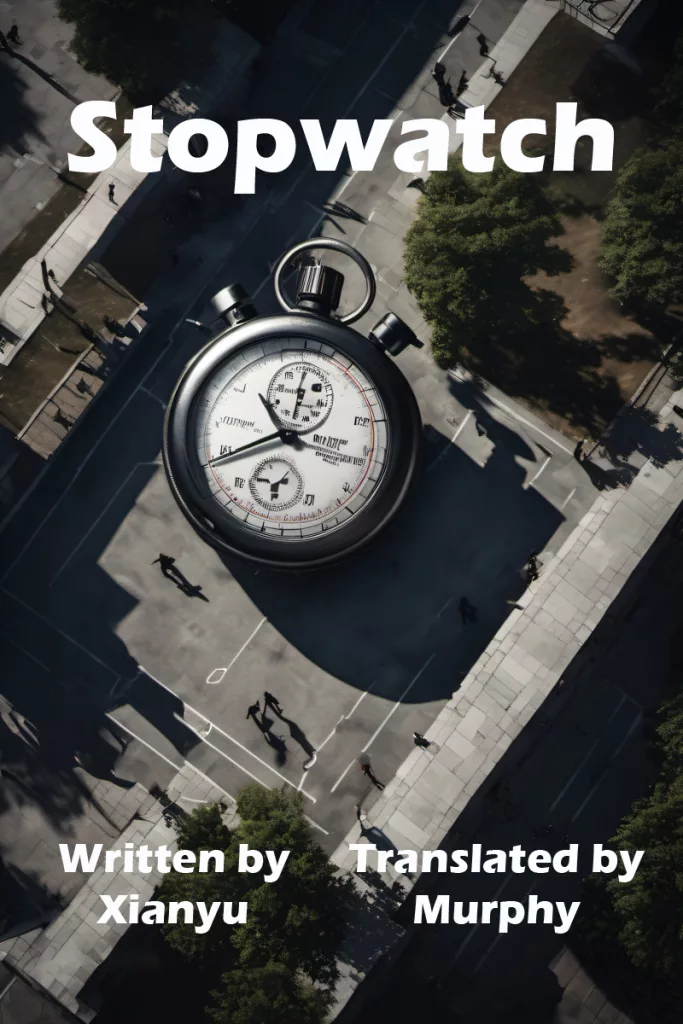
Stopwatch
Miss Qiu Series, Book 4, by Xianyu
Translated by Murphy
Copyright Information
Copyright © 2026 by Murphy
Originally published in Chinese as “秒表” by 咸鱼 (Xianyu– Lit. Salted Fish) Second Edition. January 04, 2025. Copyright © 2025
English Translation © 2026 by Murphy
All rights reserved. No part of this book may be reproduced, stored in a retrieval system, or transmitted in any form or by any means, electronic, mechanical, photocopying, recording, or otherwise, without the prior written permission of the publisher.
This is a work of fiction. Names, characters, places, and incidents are products of the author’s imagination or are used fictitiously. Any resemblance to actual events, locales, or persons, living or dead, is entirely coincidental.
www.murphyseyes.com
E-mail: [email protected]
Content
Chapter 1: Stopwatch
Chapter 2: Case 319
Chapter 3: The Private Club Raid
Chapter 4: The Astana Performance
Chapter 5: The Phantom’s Solo Concert
Chapter 6: Private Conversations with Presidents
Chapter 7: I Am Not Miss Qiu
Chapter 8: Yaroslavl on the Volga River
Chapter 1: Stopwatch
The night was heavy, and looking down from the airplane window, the shape of Quanzhou sprawled like described in a poem: “Countless homes ablaze around the city, a galaxy reflected in the water.” [Translator Note: The poem is from Bai Juyi (白居易), a renowned Tang dynasty poet. It’s from his poem《江楼夕望招客》 (Evening View from River Tower, Inviting Guests).]
The aircraft began its descent. Qiu Tian moved her head from the window and leaned back against Xia Xiaoyu’s shoulder, gently closing her eyes.
Happiness and joy were never late in coming, but the Little New Year in the south always arrived a day after it did in the north. Having just celebrated the Little New Year in the north, Qiu Tian and Xia Xiaoyu flew to Quanzhou on the Little New Year in the south to spend a brief time with her mother, who was wintering and recuperating there, staying until the twenty-seventh of the twelfth lunar month.
Li Changchun had arrived two days prior, having taken leave to visit family. He would spend the Spring Festival with Qiu Qingli before returning to the Bureau Two Training Center on the seventh day of the new year.
Although the trip was ostensibly a family visit to Quanzhou, Qiu Tian also had an assignment to complete along the way. On the twenty-eighth of the twelfth lunar month, Xia Xiaoyu would return to Beidu, while Qiu Tian would travel to Guangzhou to meet with Director Xiang Wenyu of Bureau Two’s South China Division and Political Commissar Zhang Zhengxin. At that time, Qiu Tian would deliver a classified mission to the South China Division.
When Director Xiang Wenyu saw Qiu Tian, he couldn’t quite conceal his surprise. Director Hao had given Director Xiang a heads-up, mentioning that the incoming Deputy Director visiting Guangzhou was young. However, Xiang hadn’t fully grasped the implications of the word “young.” Bureau Two of the General Staff was a Theater-level unit; a deputy director should, at the very least, hold the rank of Lieutenant General. He hadn’t expected the Deputy Director to be so young—he hadn’t encountered, or even heard of, a Lieutenant General in her early thirties. Qiu Tian was dressed in civilian clothes, and Director Xiang couldn’t gauge her career through any visible decorations. It was their first meeting, and asking about a new leader’s background so directly felt impolite and lacking in composure. His curiosity, therefore, remained unspoken.
After a brief exchange of pleasantries, Qiu Tian got straight to the point.
Intelligence personnel from Bureau Two in the United States had relayed important information: the U.S. Department of Defense had acquired complete and detailed information on the Rocket Force’s deployments in Guangdong and Guangxi provinces. The intelligence obtained was so granular it extended down to the location and personnel rosters of company-level units. The source of the leak was a Pentagon asset embedded within the Chinese military. Currently, all they knew about this asset was their codename: “Stopwatch.” They possessed no other information—not even their gender.
The mission for the South China Division was to investigate personnel within the Southern Theater Command, identifying potential suspects. Bureau Two headquarters would simultaneously investigate individuals at higher levels, striving to identify the “Stopwatch” as quickly as possible.
Having assigned the task, the South China Division reported a case they had recently taken on and sought Qiu Tian’s guidance on how to proceed.
Shanghai Ciji Health Group specializes in health checkups and third-party medical testing, operating checkup and medical testing centers in over forty major cities across the country.
The owner of Shanghai Ciji, Jia Jici, is a well-known entrepreneur and philanthropist. All units under the “Ciji” banner implement a special charitable policy nationwide: free health checkups for low-income groups every Wednesday and Saturday from 7 PM to 10 PM, free checkups for the first 200 local residents who book appointments through the website or mobile app every Sunday, and all-day free service for police officers, military personnel, and their dependents. This policy has earned the Ciji Group a strong reputation for social responsibility.
Two months ago, a theft occurred in the “Xiuzhong Building,” a commercial office building in Guangzhou. The building’s property management reported the incident to the police, who quickly apprehended one of the thieves. He implicated his accomplice and detailed the theft, including stealing over 300,000 Yuan in cash, two laptops, and other items from an office room within the “Guangzhou Ciji Health Checkup and Medical Testing Center” on the fourth floor. However, “Ciji” did not report the incident. Moreover, during the police’s follow-up investigation of the theft, Ciji informed the police that they had not been robbed.
Several days later, the thief’s accomplice was found severely beaten and dumped on the side of the road, brought to the hospital by a kind passerby who alerted the police. When questioned by the police, the thief initially refused to disclose the details of the assault, only revealing it during interrogation about the theft.
The thief was named Qi Liang. He and his already-arrested accomplice were university classmates, both with backgrounds in engineering. Ultimately, their laziness and desire for easy money led them to what they considered a shortcut in life. They specialized in burglarizing office buildings, stealing small, high-value electronic devices to resell to buyers connected to online retailers. If they happened to grab some cash during a robbery, they considered it a bonus. Many of the victimized companies considered the losses minor, found reporting to the police too complicated, and either remained silent or simply complained to building management. The pair’s criminal activity went largely unnoticed, allowing them to operate with increasing confidence.
After his accomplice was arrested, Qi Liang hastily rented a new apartment and went into hiding. The police couldn’t find him, but he was abducted by four unfamiliar men and taken to a dilapidated factory. They demanded him to return the two laptops and a portable hard drive he’d stolen from “Ciji.”
After a brutal beating, Qi Liang confessed everything, revealing the contact at the online retailer who purchased the stolen goods. But his tormentors beat him again, telling him as they dumped him on the side of the road that the 300,000 yuan he’d stolen from “Ciji” would cover the silence and his medical bills. If Qi Liang talked out of turn, or if they couldn’t recover the laptop and hard drive, the money would instead be used to buy him a grave.
Qi Liang held back one piece of information. He hadn’t sold the hard drive, but had hidden it. He told the police the hard drive contained a massive amount of personal information and corresponding HNA—hypoxia nucleic acid—records, covering a vast number of individuals. He’d planned to sell the personal information, intending to make many times more money than he would have by simply selling the hard drive.
The police investigation revealed that the stolen goods buyer at the online retailer had disappeared. After excavating the location Qi Liang indicated, they recovered the hard drive and discovered that the so-called “hypoxia nucleic acid” should be correctly referred to DNA sequencing and genomic data. The records contained detailed personal information on a vast number of individuals, including a large number of active military personnel and their families. The police reported the situation to the military’s security department.
“Director Xiang, where is Jia Jici currently?” Qiu Tian asked.
“He returned from the United States a couple of days ago and went straight to Guangzhou before heading back to Shanghai. According to the latest intelligence, he plans to spend the Spring Festival at his hometown in Wuhan, Hubei Province. We don’t have any information on his movements beyond that, nor has he booked any plane or train tickets.”
Qiu Tian nodded, addressing Director Xiang and Political Commissar Zhang. “Here’s how we’ll proceed. First, the South China Division coordinates with the Guangzhou police. This case involves active military personnel and their families, so Bureau Two will take the lead. Second, it’s already the twenty-eighth of the twelfth lunar month; let’s hold off on taking action against ‘Ciji’ for now. The South China Division should immediately monitor Jia Jici himself, and we’ll arrest him when the unified operation is launched. Third, I’ll arrange a nationwide coordinated operation at 11:30 PM on New Year’s Eve to raid Ciji’s facilities across the country and apprehend core personnel. Fourth, the South China Division will oversee the implementation of this unified operation, be responsible for investigating the case, and all evidence and suspects from other regions will be transferred to the South China Division for final reporting to Bureau Two Headquarters. Fifth, the South China Division is the first to know about this assignment, so maintain strict confidentiality.”
Director Xiang hesitated for a moment, then voiced his concerns. “Shouldn’t we conduct a more thorough investigation before taking action? This is a nationwide operation, and Ciji is a well-known company. I’m worried that if we’re wrong…”
“We’re already reacting to events that have already unfolded. The enemy moved first, and we’re playing catch-up. We can only make up for lost time by acting swiftly. Let’s secure the people and evidence first, and then we can conduct a deeper investigation more easily.” Seeing Qiu Tian’s resolute stance, Director Xiang, though still harboring reservations, didn’t press the matter further.
Seeing Qiu Tian arrive in Guangzhou alone, in civilian clothes, Political Commissar Zhang Zhengxin asked with concern, “Deputy Director Qiu, I see you haven’t brought a security detail or a secretary, and you’re dressed in plain clothes. It’s the end of the year, and security is a little more lax than usual. Would you like us to assign two officers from the South China Division to escort you back?”
“Thank you, Political Commissar. This trip is a combination of visiting family and a business trip, so I intentionally didn’t bring my secretary. I requested the Bureau not be assigned a security detail—I’m used to traveling alone. It’s almost New Year holidays, so please don’t trouble your colleagues to escort me.”
“A thousand families laugh, the sound lingers late; trouble and woe seep in from beyond.” [Translator Note: The above two lines are from the poem “New Year’s Eve” by Huang Jingren (黃景仁) of the Qing Dynasty.]
During the Spring Festival, Bureau Two leaders were on duty. Deputy Director Ma Xiao was on duty on New Year’s Eve, Director Hao on the first day of the New Year. Qiu Tian had already visited her mother before the New Year, so she wouldn’t be visiting her mother on the second day. She was therefore assigned duty on the second day of the New Year.
Shortly after 1:00 AM on New Year’s Day, Director Hao called.
“Director, Happy New Year! I’m wishing you well for the New Year!”
“Happy New Year to you! Happy New Year! Qiu Tian, where are you?”
“Xia Xiaoyu and I just left my mother-in-law’ home and we are on our way back to Wutong Street.”
“Perfect. Come to the Bureau immediately, and go directly to Conference Room 3 in the Internal Security Division. I’ve already dispatched a driver to pick you up from Wutong Street, so don’t drive yourself. Bring a weapon, classified as a Level Three operation.”
Seeing that everyone had arrived, Deputy Director Ma Xiao, who was on duty, began to brief the situation. A dam at a reservoir in a certain area of Guizhou province had been destroyed with explosives shortly after 11:00 PM on New Year’s Eve. The dam’s collapse caused flooding that submerged eight counties and two cities downstream, resulting in over 230 confirmed deaths. Vast areas of farmland and homes were inundated, and nearby military units had rushed to the scene to provide rescue efforts. The full extent of the damage was still being assessed. Almost simultaneously with the explosion, a flood of information appeared on the internet, the vast majority accusing the Chinese government of using festive displays to cover up the suffering of its people.
Police and Armed Police forces had apprehended five suspects near the scene and were being transported to Bureau Two via military aircraft. The incident was provisionally classified as a malicious act of terrorism, and Bureau Two was tasked with urgently interrogating the suspects to identify the perpetrators and those orchestrating the attack.
Director Hao, his expression grave, glanced at Director Guan Dongtian. Seeing Director Guan wave his hand, Director Hao began assigning tasks. “Qiu Tian will lead the intensive interrogation, quickly breaking through the defenses of one or two suspects. Ouyang, you ‘Three Great Titans’ will swiftly take down the remaining suspects based on the results of the interrogation.” He then turned to the Political Commissar. “Political Commissar?”
“Carrying out a terrorist attack on New Year’s Eve, simultaneously waging a war of public opinion online…it’s malicious intent, extremely heinous. This has already alarmed the Central authorities and the Central Military Commission. We must act quickly, decisively, while also being mindful of the potential repercussions.” The Political Commissar stated his position.
“Let’s all prepare separately. Begin as soon as the suspects are delivered here,” Director Hao ordered.
Qiu Tian circled the line of five suspects twice before stopping in front of two with foreign faces. She scanned them both, then asked in English, “What language do you speak?”
Receiving no answer, Qiu Tian pointed to the more imposing of the two. “Let’s assume you speak English, then we’ll start with you. What’s your name?”
When he remained silent, Qiu Tian seemed to be talking to herself. “Then you’re ‘John.’ Pleased to meet you, John.”
The heating had been turned off in the dissection room. “John,” handcuffed and lying on the stainless-steel autopsy table, cautiously scanned his surroundings. The room’s stark, white lights were glaring and cold, the stainless-steel furniture and various surgical instruments radiating a chill. The scent of chemical reagents offered no comfort, and the stainless-steel table beneath him was perhaps the coldest “bed” he’d ever lain on. The cold seeped through his exposed skin, pressed against the metal, and chilled him to the bone.
Someone had already wheeled in a cart loaded with the equipment Qiu Tian needed and pushed it into the dissection room. She sized up “John,” then lifted a vise from the cart, placing it on the autopsy table and adjusting its position. She positioned his right ankle in the vise and began to slowly tighten the handle. A faint, grating sound of metal on metal filled the room as the vise clamped down on his anklebone.
Qiu Tian suddenly exerted force, rapidly rotating the vise’s handle. A searing pain shot from his ankle to his forehead, and “John” let out a cry, straining every muscle in his body as he sat up. Qiu Tian raised her hand and struck him sharply on the throat. “John” crashed back onto the autopsy table, groaning in agony.
“So, you’re a creature capable of making sound. I suppose we can still try to communicate,” Qiu Tian said, using another vise to clamp his left ankle. Lying on the autopsy table, “John” didn’t feel particularly acute pain in his left foot. He guessed that his interrogator merely intended to use a heavy object to secure his leg, without intending to do anything further to his ankle.
Qiu Tian repeatedly carried three sandbags from the equipment cart, stacking them neatly on “John’s” chest. Then, she turned on the faucet connected to the hose used for rinsing the autopsy table, testing the temperature of the clear water flowing from the nozzle. She began to pour water onto the sandbags. The cold water streamed down the outer walls of the bags, soaking “John’s” exposed upper body, then running down the tabletop to his feet. The stainless-steel surface of the autopsy table conducted the bone-chilling cold to his back, waist, and legs, while the water itself playfully drained away quietly through the table’s outlet.
The sandbags gradually became saturated, the thirsty sand inside greedily absorbing the water, growing heavier and heavier, and finally transferring that weight to “John’s” chest, causing him to feel increasingly suffocated.
Qiu Tian rotated the handle of the vise, and unbearable pain shot from “John’s” left ankle to his entire body. He felt his ankle begin to heat up, but this heat didn’t bring warmth—instead, it created a burning, itching sensation, as if countless tiny insects were crawling from his ankle.
Soon, his right ankle felt the same way. Struggling to breathe, overwhelmed by suffocation and despair, he couldn’t even muster the ability to scream. He could only barely maintain his breathing, the sharp pain in his feet temporarily keeping him conscious.
That beautiful, delicate face reappeared before “John’s” eyes, but his vision was blurred with tears.
“Is there anything you’d like to tell me, John?” Qiu Tian asked.
“John’s” upper body was pressed by the cold, wet weight of the sandbags, restricting his chest and making it difficult to breathe. But he still managed to force out a voice, speaking with defiant determination. “Fuck the bloody you!”
“I admire your positive attitude toward life, to still have such a vivid imagination at a time like this.” With that, Qiu Tian disappeared from “John’s” sight. Lying flat on the autopsy table, “John” could only see the harsh light from the overhead lamp. His shins were sending intense emergency signals to his brain—the result of Qiu Tian tapping them with a surgical hammer.
“John” wished his legs would simply break, even if it meant losing both of them. At least the pain would be over. But her strikes were perfectly calibrated, delivered with a unique rhythm that caught him off guard with each blow. He couldn’t endure it for long and abandoned his resistance.
“Gilbert. My name is Gilbert. Special Air Service, British Royal Air Force.” Gilbert could only speak in a weak voice, but it was clear enough in the quiet dissection room.
“Hello, Mr. Gilbert!” Qiu Tian greeted him absently, her attention still focused on the task at hand. She didn’t interrupt the ongoing conversation. “May I ask your full name, Mr. Gilbert?”
“Harry. Harry Gilbert.”
“Harry, may I call you Harry? What’s your comrade’s name?”
“We call him Frank. I don’t know if that’s his real name. He’s with MI6.”
“Are there any other names I should know, Harry?” Qiu Tian asked, continuing to methodically tap with the surgical hammer.
“Sean Greenwald, Special Air Service, British Royal Air Force. But I don’t know where he is. We separated after the explosion. There were three of us total, the rest were Chinese nationals.”
Qiu Tian finally stopped her percussive exploration of Harry Gilbert’s shins and reappeared in his line of sight, beginning to engage him in a focused conversation.
Director Ouyang Zhong had been observing Qiu Tian’s interrogation through the monitor, said with a touch of admiration, “The speed is incredible. She’s mastered the timing and control of both the psychological and physical aspects of the interrogation perfectly!” He then asked, “Director Hao, if you don’t mind me asking one simple question, where did Deputy Director Qiu learn these techniques? Is there a chance we could receive similar training?”
“Ouyang, you’re asking two questions,” Director Hao replied, without directly addressing the query.
Guan Dongtian, however, patted Ouyang Zhong on the shoulder with a smile. “Ouyang, let me put you through these methods. If you can withstand it, you’ll likely be even better than Qiu Tian.”
“Director, you’re teasing me again. Who could endure that?”
“I’m not joking. You’re an expert interrogator, without a doubt. Every member of Bureau Two’s ‘Three Great Titans’ earned their reputation. But when it comes to torture, Qiu Tian didn’t learn it. During her training, she personally endured all kinds of extreme methods, and she withstood them all. That’s why she’s an expert in resisting torture, and simultaneously, an expert in administering it.”
Based on Gilbert’s testimony, Director Hao ordered the “Three Great Titans” to lead separate interrogation teams for the remaining four suspects. Within hours, all four had confessed to their crimes and revealed the identities of other fugitives. Bureau Two immediately launched a manhunt, apprehending a total of nine individuals, including Sean Greenwald.
Despite China publicly releasing the evidence, Britain predictably denied any involvement in organizing or carrying out terrorist attacks within Chinese territory. They even denied that Harry Gilbert, Sean Greenwald, and Francis Essex – also known as Frank, the British MI6 operative – were British citizens, while simultaneously demanding that China uphold humanitarian principles, treat the three men with respect, and release them unconditionally.
China consequently decided to implement reciprocal retaliatory measures against Britain.
The Shanghai Ciji Health Group case had been concluded. According to the testimony of Jia Jici, the owner of Ciji Health Group, the company had illegally collected vast amounts of personal information and biological samples from Chinese citizens – particularly active military personnel and law enforcement officers – through its nationwide network of clinics. They had been conducting illegal DNA sequencing and periodically providing the data to the U.S. Department of Homeland Security. Ciji was also, at the behest of the U.S., planning to establish dental clinics nationwide, intending to use them as a cover for secretly injecting active military personnel with reagents to interfere with and recombine their genes under the guise of public health services.
Seeing Director Xiang Wenyu, looking pleased with himself, personally delivering the case results to Bureau Two, Director Hao called him over.
“Wenyu, how did it go? The South China Division’s first independent investigation of a nationwide case – you must be feeling good about it. It’s written all over your face!”
“Yes, Director. Deputy Director Qiu certainly has a knack for motivation. Assigning such a large case to the South China Division for independent investigation had everyone working themselves to the bone, but not a single person complained. They feel valued and are incredibly energized. Now, my team is running around looking for more cases, they can’t get enough!”
“Looks like morale has improved?”
“Director, morale in the South China Division was always very high, just it’s exceptionally higher now!”
“You always know what to say, silver-tongued! I think this arrangement is excellent. The Bureau is already short-staffed, so this is a win-win.”
“Director, I heard that the personnel from the South China Division involved in the case will be collectively awarded Third-Class Merits?” Director Xiang asked, lowering his voice.
“You’re remarkably well-informed! It seems you haven’t had a minute to spare since arriving in Beijing. What else have you heard? Let me in on the gossip.”
Xiang Wenyu feigned mystery, leaning close to Director Hao’s ear and whispering, “I heard Deputy Director Qiu is the daughter of the retired Director Qiu. Is that true?”
“It is. However, we at Bureau Two have never relied on connections; it’s all about merit. Let me tell you something. Deputy Director Qiu was specially recruited into the military at the age of nine and has served for 24 years now—two years less than you, I presume?”
Director Xiang thought for a moment. “That’s right. I’m nearing fifty, and I’ve only been in the military for 27 years.”
“She wasn’t given any preferential treatment. To put it in old terms, Deputy Director Qiu comes from a military family, and she’s earned her stripes fighting real battles with real weapons since the day she enlisted. She’s a warrior.”
“That explains why she doesn’t even bring a security detail. A tiger cub from a military family, a young hero—I’m impressed.”
“Wenyu, I’m telling you all this so you know the truth, regardless of what rumors are circulating. You must fully cooperate with her on all matters. Don’t let her age fool you; look at her years of service. She’s not someone to be trifled with.”
“Yes, Director! I guarantee full cooperation.”
Director Hao remembered something else. “By the way, Wenyu, is there any progress on the ‘Stopwatch’ case?”
“The pool of suspicious individuals within the Southern Theater Command has been narrowed down to two. I’ve already briefed Deputy Director Qiu on the details.”
Zhang Weiheng was sitting at a window table in the coffee shop, reading a book. The cafe was small, with only six tables, all occupied.
For over three years, as long as he wasn’t working overtime, Zhang Weiheng would come here every Saturday afternoon at four o’clock.
Zhang Weiheng couldn’t recall how he’d first stumbled upon this unassuming café. Perhaps it was simply by chance, as there were so many coincidences in life that defied scientific calculation. He’d overheard customers chatting and learned that the owner, a woman, had ventured from Qinghai to Shenzhen and then Guangzhou, opening this small café and running the business herself.
He’d sat at the same window table on his first visit. He enjoyed sitting quietly by the window in the afternoon sun, watching the milky fog swirl and rise in his coffee cup, slowly drifting upwards before dissipating in the warm sunlight—or perhaps being melted by its intensity. He liked to sit quietly by the window, observing the hurried pedestrians on the small street, studying their expressions and gestures, speculating about their pasts, and predicting their futures. He enjoyed sitting quietly by the window, watching the owner bustle about, admiring her every movement, savoring her smiles and frowns, and using the time to read a few pages of his book, avoiding too much eye contact with her fiery yet gentle gaze.
Zhang Weiheng could tell, and could feel, that her gaze was only so warm when directed at him. When she looked at other customers, it was merely the polite warmth of someone providing service. He and the owner always exchanged courteous greetings, perhaps a few idle words when the cafe wasn’t busy, but he knew she kept that table reserved for him. Every Saturday afternoon, if he didn’t come, the table would remain empty.
Now, when Zhang Weiheng visited the café, he no longer needed to order coffee. As soon as he sat down, the owner would quickly bring him a freshly brewed cup. He didn’t know what kind of coffee it was, or what made it special, but he knew it always tasted excellent, even carrying a hint of the owner’s delicate fragrance. The coffee’s temperature perfectly matched the warmth of her gaze—it was never cold.
Senior Colonel Zhang Weiheng was the director and staff officer of the Fourth Operations Command Center within the Southern Theater Command.
Sitting in the coffee shop, he was reading a psychology book, intending to finish the remaining chapters today. He and the café owner had a long-standing, unspoken connection, but nothing had ever transpired between them. Zhang Weiheng was 48 years old, still unmarried, and without a girlfriend. He estimated the owner was in her early thirties, and he felt the age gap was too significant—perhaps silently admiring her was a happiness in itself. The owner, in turn, always maintained a respectful distance, never saying too much or crossing any boundaries. This only made Zhang Weiheng admire her more and enjoy their platonic relationship even more.
The Fourth Operations Command Center of the Southern Theater was responsible for the training and operations of the rocket forces under the Theater’s command, as well as coordinating joint operations with other military branches within the war zone. Zhang Weiheng had studied rocketry in college and joined a missile unit after graduation, making it a perfect professional fit.
Zhang Weiheng was relatively introverted. He disliked superficial socializing, and even avoided it altogether, dedicating himself to his work and spending his free time reading. He joined the military after graduating from university, proactively requesting assignment to a grassroots unit for training. He had a deep understanding of the needs and common problems faced by frontline soldiers. After returning to headquarters, he continued to visit frontline units, gradually proposing numerous targeted improvement suggestions, earning the attention and appreciation of his leaders. He was now a capable leader, serving as the director and staff officer of the Fourth Operations Command Center.
Zhang Weiheng was particularly engrossed in his reading today. The translated psychology book, originally written in a foreign language, was somewhat difficult to decipher, but its content was profoundly insightful. He savored the theories presented in the book, comparing them to examples within and reflecting on his own personality, attempting to analyze why he was so introverted. Introversion itself wasn’t a problem, but his tendency to be passive and avoid confrontation wasn’t the outcome he desired. Zhang Weiheng was proactive at work, but he knew deep down it was a reactive proactivity—a deliberate attempt to appear engaged, a habit that had been well-masked for years. He’d identified the issue and wanted to change. This book offered him much inspiration, and he hoped he could consciously try to make some adjustments.
Zhang Weiheng glanced down and realized there were only ten pages left. He suddenly felt reluctant to finish it. He looked up and realized the café was empty of other customers. He offered the owner an apologetic smile. “I’m sorry, I’m holding you up from closing. My book is almost finished. Would you mind if I stayed a little longer and finished it here?”
The owner brought over two freshly made coffees, placing one in front of Zhang Weiheng.
“You read your book, I’ll wash the cups. Let’s not disturb each other.” The owner smiled sweetly, turning back to the counter and resuming her work.
Finally finishing the book, Zhang Weiheng still felt somewhat reluctant to put it down. He glanced at his watch, stood up, and turned toward the door, offering the owner a farewell greeting.
“Hey!” The owner called out to him.
“What is it?”
The owner stared at Zhang Weiheng, a touch of reproach in her eyes. “You don’t want to settle the bill?”
Zhang Weiheng suddenly remembered he hadn’t paid for the second cup of coffee. He said apologetically, “Sorry, I was so lost in the book that I completely forgot.” He walked back to the counter and handed the money to the owner.
“Hey!” The owner called out to Zhang Weiheng as he turned to leave.
“Ah? Is something wrong?”
“Is that all? You don’t want to settle other accounts with me?”
Hearing this, Zhang Weiheng was confused. “What other accounts? Sorry, I don’t remember. Could you remind me?”
“I closed up early today, sending all the other customers away. Today marks exactly three years and six months since you’ve been coming here. Don’t you want to talk about our feelings?” The owner’s eyes were glistening with tears.
Zhang Weiheng was suddenly stunned, feeling flustered and at a loss for words.
“I… I’m from the military camp across the street, I’m 48 years old, much older than you… I came, then I… later I…” This was perhaps the first time in his life that Zhang Weiheng had stammered and struggled to find the right words.
“I didn’t ask about your age. I asked about your feelings.” The owner interrupted him.
Seeing that Zhang Weiheng remained silent, idly rubbing the cover of his book, the owner asked, “Have I been imagining things?” Tears began to stream down her face.
Zhang Weiheng hurriedly grabbed two tissues from the box on the counter and handed them to the owner. “No, don’t misunderstand. I like you, I like you very much, but we’re too far apart in age. I wouldn’t dare to hope.”
“Is age so important to you? Or is feeling more important?”
“It’s not that simple, it’s not absolute. Feelings, yes, feelings are more important. I read this book today, and I suddenly understood a lot of things. I was planning to go back and reflect on myself.” Zhang Weiheng suddenly felt disoriented. He felt the dam he’d guarded for years within his heart had been breached by the owner’s tears, leaving him completely defenseless and overwhelmed by a flood of emotion.
“I’m hungry.”
“I’m hungry too. Let me treat you to dinner. Give me a chance!” Zhang Weiheng quickly tucked the book under his arm.
The owner finally broke into a smile through her tears.
Inside a private room in an exclusive club, the dishes on the table remained largely untouched, while an Italian red wine bottle lay empty. Fine cuisine lay cooling as empty glasses hinted at blurred lines and hazy intentions.
Hearing the melodious singing from within the room, a waitress standing outside softly asked her colleague, “Sister Fen, who is the woman singing? She has a beautiful voice!”
“Remember, when you work here, never ask questions you shouldn’t! That woman is from the People’s Liberation Army Arts Troupe, a professional. Of course she sings well!” Xiao Fen replied.
Just then, the service bell rang. Xiao Fen quickly went inside, then emerged shortly after, taking a bottle of Spanish red wine with her and delivering it to the room.
Providing entertainment with her singing was Liu Ying, a leading soloist and nationally-renowned performer with the People’s Liberation Army Arts Troupe. The older man seated beside her was General Ge Laiguang, commander of the Rocket Force.
General Ge’s wife, Jin Sumei, had previously been a department director at the Ministry of Agriculture, and later became a vice-chairman of the Grain Import and Export Group, primarily responsible for long-term enterprise planning, integration with diverse social sectors, and research projects concerning agricultural production and adaptation to climate change.
Jin Sumei wasn’t particularly familiar with the layout of her office, preferring to spend her time with a close circle of “sisters” at mahjong tables, where they both relaxed and conducted business.
Jin Sumei was especially fortunate at mahjong, particularly skilled at playing with single “Yaoji” dragon tiles. Her well-connected friends affectionately called her “Sister Yaoji,” but this nickname was strictly reserved for those who met certain criteria. A sister’s husband had to hold a high rank, the friendships had to be mutually beneficial, and the sister’s losses at the table had to be substantial. If any of those conditions weren’t met, Jin Sumei considered the person’s qualifications “incomplete,” and such a person had no right to join the game, let alone presumptuously address her as “Sister Yaoji” to curry favor.
Liu Ying’s husband, Du Xinshi, was a native of Beijing. It was said that his maternal grandfather had played the Jinghu in the band of the notorious Peking Opera master “Boss Shang” before the Liberation. Du Xinshi had studied instruments at the Children’s Palace since childhood, and seemingly inherited his grandfather’s musical talent. He could play both bowed and plucked string instruments, and by the age of 17, he was a Ruan player with the People’s Armed Police Arts Troupe, often filling in wherever needed, playing the Sanxian, Erhu, and even percussion. He met the then-15-year-old rural girl Liu Ying while performing a troop comfort show two years later. The two young lovers spent several days together after dusk, he playing and she singing. Du Xinshi nearly faced disciplinary action for violating regulations by going out without permission, but the trouble was avoided when the director of the Arts Troupe, impressed by Liu Ying’s voice, decided to recruit her into the People’s Armed Police Arts Troupe, sparing Du Xinshi from punishment—though he did receive two kicks to the rear from the director, the imprints of the director’s size 43 shoes being scrubbed away by Liu Ying herself.
Liu Ying was diligent and eager to learn, and combined with her natural talent, she began to excel within the People’s Armed Police Arts Troupe after only two years. Her entire demeanor underwent a dramatic transformation; she was no longer the simple girl from the countryside. To the frustration of the Arts Troupe’s director, who cursed for three straight days, this promising talent was snatched up by the General Political Department Arts Troupe.
Liu Ying married Du Xinshi shortly after reaching legal marriageable age. Although they no longer worked at the same unit, their life together was peaceful and harmonious. As Liu Ying’s career flourished and she became increasingly busy, the couple saw each other less and less.
After the military reforms, Liu Ying was transferred to the People’s Liberation Army Arts Troupe, entering as a leading soloist. The People’s Armed Police Arts Troupe was disbanded, and Du Xinshi, originally intending to use connections to secure a position as a music teacher in a middle school, unexpectedly found himself transferred to the People’s Liberation Army Arts Troupe, and within a year, became its vice director.
He was thriving in his career, but unfortunately, the couple had very little time together. When Liu Ying was in Beijing, Du Xinshi was often traveling in another province. And when Liu Ying went on tour, Du Xinshi was usually even further away. The only time allowing Du Xinshi to return to Beijing to visit his mother and, incidentally, check the doors and windows and utilities of their home, was when Liu Ying went abroad for performances.
The service bell rang again. Xiao Fen glanced at her watch. According to the customers’ habits, it was time to clear the dishes. She called over her colleague and they entered the private room, efficiently clearing the table and quietly exiting. The two girls reported back to the manager and went to their dormitories to rest.
This exclusive club was owned by a childhood friend of General Ge Laiguang. It was private and luxurious. The top-floor private room occupied by Ge Laiguang looked like a VIP dining room, but a hidden door led to an inner suite designed and built like a presidential suite in a five-star hotel. Ge Laiguang and Liu Ying were regulars. As the general’s childhood friend, the club owner naturally wouldn’t stoop to charging him for meals or accommodations—brotherhood was more valuable than money, especially considering Ge Laiguang often brought business to the club.
Seeing the two waitresses leave, Ge Laiguang and Liu Ying entered the inner suite. The suite was extremely private, and no one knew what the two of them would be discussing for the entire night, or what would keep them sleepless.
This year, Gao Fuchen, Deputy Director of the Political Department of the Southern Theater, was sixty-four years old. Believing he had little chance of further advancement, he sought inner peace and good health, content to wait for a smooth retirement and enjoy his golden years. Every morning, Gao Fuchen would begin by practicing Tai Chi in the park, followed by “practicing Tai Chi” for his mind in the office after breakfast. Some colleagues jokingly called him “Gao Tai Chi,” but realizing it might be inappropriate, they revised the nickname to “Too Advanced” as a discreet substitute.
Gao Fuchen was the son of a founding general, a staunch member of the “second generation” of revolutionaries and military family. His family had a strict upbringing, and he himself placed great emphasis on appearance. Every week, a barber would come to his home to maintain his already neat crew cut, and he would get a touch-up before important meetings. His colleagues admired his dignified appearance, imposing demeanor, and harmonious countenance. His wife was even prouder, boasting to anyone who would listen about how “stylish” Lao Gao was.
Gao Fuchen’s wife, Yang Ruliu, wasn’t in good health. While she didn’t suffer from any serious illness, she was frequently plagued by minor ailments. Gao Fuchen felt deeply sorry for his wife, so he specially hired a traditional Chinese medicine doctor to visit their home every week to take her pulse, prescribe remedies, or administer acupuncture and massage. Gao Fuchen was skilled in ink wash painting and a gifted calligrapher. Whenever the doctor dictated a prescription, Gao Fuchen would write it out beautifully in calligraphy. The pharmacists at the nearby pharmacy often praised his writing, saying it was “too advanced” that reading the prescription was like studying a calligraphy manual of the “Gao Style.” Gao Fuchen thoroughly enjoyed the compliment.
Shen Wangzu, Deputy Chief of Staff of the Rocket Force, was a man of action, and his frequently hawkish rhetoric toward opposing forces – even suggesting preemptive, decisive nuclear strikes – had long made him controversial. The Rocket Force’s political commissar had repeatedly warned him to conduct more research and speak less during peacetime, to avoid causing trouble. Shen would quiet down for a while after being reprimanded, but after a month or two, he would begin speaking out again. Over time, everyone grew accustomed to it, and given his outstanding professional abilities, the commissar largely stopped intervening, figuring it was just “missiles from the mouth” and letting him have his say.
Shen Wangzu was full of energy. In addition to frequently visiting frontline units and lecturing at military academies, he often accepted invitations to give national defense education lectures at universities, encouraging young students to join the military and serve the country. His speeches were passionate and motivating, and they had indeed inspired many young people to enlist. He was also a frequent presence at domestic and international military exchanges and forums, sharing his views. These statements were often secretly recorded and posted online, sparking heated discussions. The military establishment of opposing nations vehemently disliked Shen Wangzu, frequently launching verbal attacks against him and lodging strong protests with China regarding his remarks.
According to confidentiality regulations, detailed information about the Rocket Force’s deployments was archived in separate locations. Currently, only four people were confirmed to have access to the complete deployment information for the Rocket Force in Guangdong and Guangxi provinces.
Among these four individuals, the “Stopwatch” was hidden, and had been operating with precise security for quite some time.
Read → Read: Miss Qiu Series → Stopwatch