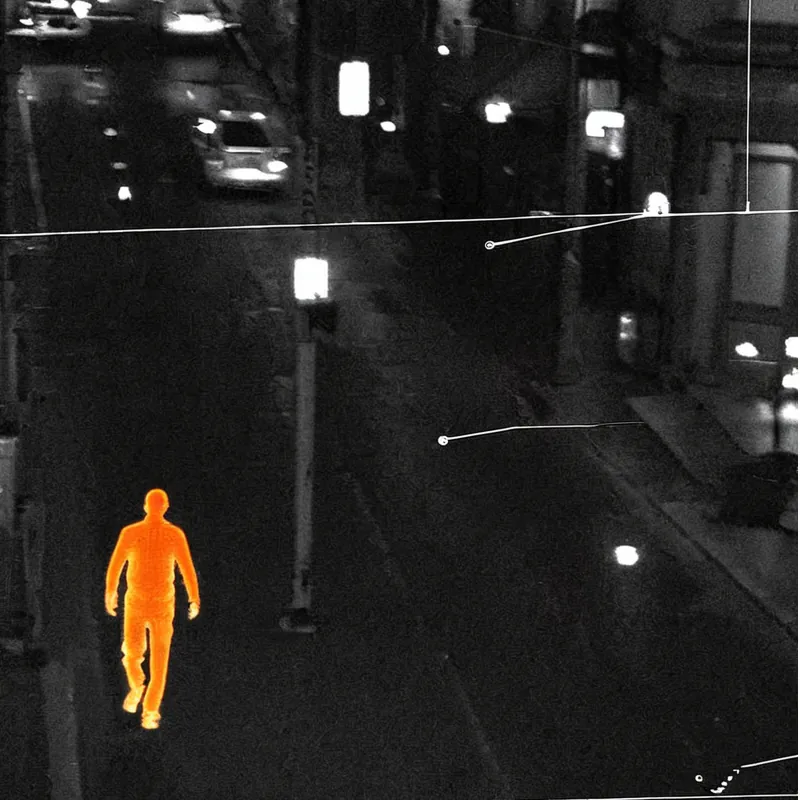
In my novella, The Logistician, the protagonist Paul Anderwood spends his life navigating the shadows of Europe. He is a man of intuition, a man who understands that intelligence isn’t just about data—it’s about the “drift.” It’s about the messy, unquantifiable nuances of human behavior: the hesitation in a stranger’s eyes, the rhythmic tension of a crowded station, the instinct that tells you a situation is wrong before the sensors do.
But Paul is operating in a world that is rapidly losing its appetite for nuance.
As he progresses through his missions, he encounters a new kind of authority: the PPE (Predictive Performance Excellence). It begins as a tool to track shipments, but it quickly evolves. It begins to track the agent. It monitors respiratory rhythms, heart rate variability, and transit timestamps. It demands “binary responses.” It treats human intuition as “unvalidated procedural drift.”
This brings me to a question I’ve been obsessed with while writing this story: In modern society, we are no longer just managing things; we are managing people through algorithms.
From Logistics to Life
Historically, algorithms were meant for logistics. We used them to optimize shipping routes, manage supply chains, and predict market fluctuations. They were tools used to handle objects.
But we have entered a new era. Today, the “optimization” has turned inward.
We see it in our workplaces, where productivity is measured by keystrokes and “active” status. We see it in our social lives, where our value is determined by engagement metrics. We see it in our very biology, where wearable tech tells us if we slept “well enough” or if our stress levels are “suboptimal.”
We are being nudged into becoming predictable data points. We are being encouraged to eliminate the “friction” of our personalities to satisfy the requirements of a seamless, automated system.
The Myth of the “Delete” Button
When we think of a technological takeover, we often imagine something dramatic—a robot uprising or a sudden loss of agency. We fear being deleted.
But in the world of The Logistician, the threat is much more subtle. The algorithm doesn’t need to delete you to win; it only needs to optimize you.
If you fight against the algorithm—if you insist on your “drift,” your spontaneity, or your messy, non-linear way of living—the system won’t necessarily erase you. Instead, it will simply find you inefficient. It will flag your behavior as an anomaly. It will categorize you as a “variable” that complicates the math.
And that is when you are sidelined.
To be sidelined by an algorithm is to become a ghost in the machine. It is to be pushed to “page 156 of the search results.” You are still in the database, you are still “active,” but you are no longer part of the primary stream. You have been optimized out of the conversation.
The Binary Trap
The danger of the algorithmic age is the “Binary Response.” The system wants a Yes or a No. It wants a clean, predictable path from Point A to Point B. It struggles to process the “grey areas” where true human intelligence actually lives.
In The Logistician, Paul realizes that the more “perfect” the system becomes, the less it actually sees. It sees the data, but it misses the truth. It sees the success of the mission, but it ignores the human cost.
As we move further into this era of predictive excellence, we have to ask ourselves: Are we willing to sacrifice our nuance to achieve perfect efficiency?
Are we prepared to become the perfect, predictable, and hollow vessels the system requires? Or can we find a way to maintain our “drift” without being optimized out of existence?
Discover the struggle for autonomy in The Logistician. Available now in ebook, paperback and audiobook, or in digital libraries.